
Financial Stewardship Is a Shared Leadership Responsibility
Charter school leaders are called to think boldly about student achievement, innovation, and opportunity. Yet one of the most important leadership responsibilities is often treated as separate from the mission itself: financial stewardship.
At Great Schools North Carolina, we believe sustainable schools require leaders who understand that financial leadership is not simply the responsibility of a back-office provider or accounting partner. It is a core part of school leadership and the school board.
However, effective financial stewardship cannot rest with a single person. Great schools are built through active partnership between executive leaders, finance teams, and boards. Financial oversight is not separate from the mission. It is part of protecting and enabling the mission.
Effective financial governance includes regular review of financial performance and forecasts, and clear oversight practices that keep organizations focused on both short-term stability and long-term impact. It also requires boards and school leadership to align on clear financial health goals, review annual and multi-year plans against strategic priorities, and thoughtfully weigh tradeoffs - for example, increased investment areas like salaries, staffing levels, or facilities may require reductions elsewhere. In this work, board treasurers and finance committees play a critical role as both strategic thought partners and accountability partners to school leadership.
That responsibility has become even more important as charter schools navigate a rapidly changing educational landscape. Enrollment is becoming more challenging everywhere. Rising costs continue to outpace revenue growth. Staffing challenges persist across the education sector. Student needs are increasing, while school expectations continue to expand. At the same time, uncertainty around federal and state funding creates additional pressure on long-term planning.
Enrollment trends are adding another layer of concern. National birth rates have declined significantly since 2007, and public school enrollment is projected to decrease by 4.2 million students by 2030. In North Carolina, net in-migration is helping offset declining birth rates, but enrollment has become increasingly challenging, as families have a wider range of options, and many areas of the state are experiencing enrollment declines. For charter schools, that means enrollment strategy can no longer be treated as a seasonal task, but rather as a year-round activity and priority with a dual focus on retaining current students and recruiting new ones. It must become part of an organization’s DNA and long-range financial planning tied directly to staffing, programming, facilities, and sustainability.
School leaders are being asked to do more with less while navigating enrollment shifts, workforce challenges, rising costs, increasing student needs, and evolving expectations. In this environment, financial leadership is no longer just an operational function. It is a strategic leadership responsibility.
That is why scenario planning has become increasingly important for charter schools. Excellent leaders prepare for and update multiple likely scenarios rather than relying on a single set of assumptions. They test different enrollment, funding, and staffing scenarios, identify potential risks, and develop contingency plans before challenges arise so they can react quickly.
In this environment, strong financial leadership matters more than ever. Financially healthy schools do more than balance a budget. They align resources with mission and strategy. They make thoughtful decisions about staffing and growth. They build reserves and contingency plans that allow them to navigate uncertainty without compromising student experience. Furthermore, building healthy reserves empowers leaders to pursue vital strategic investments, such as owning an affordable, permanent home. Most importantly, they understand that every dollar spent reflects organizational priorities, and that ultimately leadership is about creating clarity and balancing tradeoffs.
Financial health also requires a broader mindset around sustainability, resiliency, and compliance. Schools must operate within their means while building the capacity to weather unexpected challenges. They need clear financial policies and procedures, systems that support accountability across the organization, and consistent monitoring.
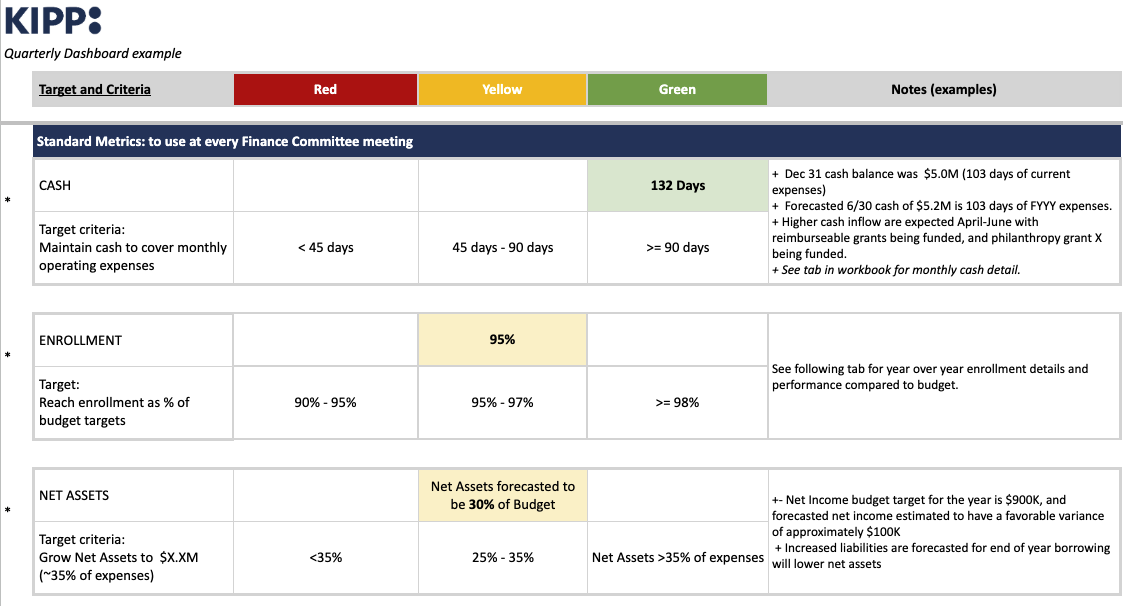
Just as schools establish goals for academics and enrollment, they should also define what financial health looks like for their organization and track progress toward it over time. See this sample financial dashboard and goals from Afton Partners and the KIPP Foundation.
As one guiding principle reminds school leaders, “Your mission is your reason.” Budgets are not just operational documents. They reflect what a school values most.
Back-office providers and external partners can offer valuable expertise, but they should support financial leadership, not replace it. School leaders and board members must own the organization’s financial strategy, goals, compliance, and resource priorities, including how resources are allocated and why. They must also build and regularly monitor a strong financial plan that evolves as conditions change.
At the heart of this work is a simple truth: financially healthy schools are better positioned to invest in their programs, staff, and facilities - providing excellent educational opportunities and becoming pillars in their communities.
That is why we continue investing in leadership development, strategic planning support, and resources that help charter school founders, leaders, and boards build sustainable schools equipped for long-term impact. As North Carolina’s charter schools continue to grow and evolve, strong financial leadership will remain essential to ensuring schools not only open successfully but thrive for years to come.